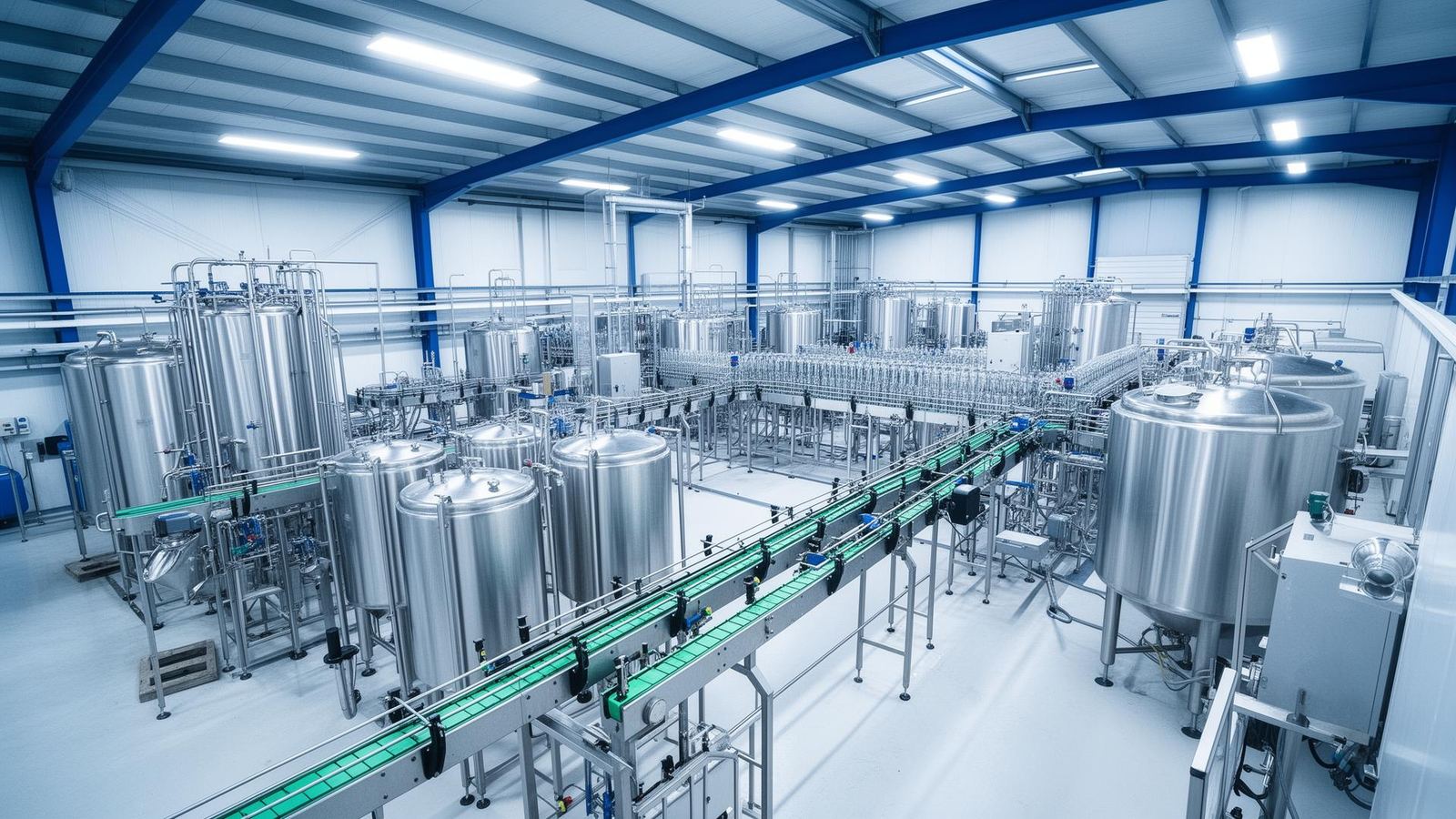
A used filling or packaging line changes risk at every project stage. A machine that performs well during inspection can still fail to meet the objective if dismantling is undocumented, utilities are undersized or acceptance criteria are vague. This checklist keeps the project traceable from first review to production handover.
1. Desktop technical review
Product, container, closure, label, pack and pallet specification.
Target net output and planned shifts.
Machine list, layout, serial numbers and year.
Available manuals, drawings, software and format lists.
Electrical standard, utilities and safety requirements.
2. On-site inspection
Photograph every machine and nameplate. Observe production start-up, steady running, stops and changeover where possible. Review the product path, wear points, leakage, noise, vibration, reject systems and operator alarms. Interview maintenance staff and document known faults without relying on memory.
3. Commercial scope
Mark what is included, excluded or available at extra cost. Clarify tanks, pumps, conveyors, coding equipment, inspection systems, tooling, platforms, guards, spare parts and documentation. State the machine condition and whether any overhaul is promised before shipment.
4. Dismantling and packing
Create a tag system for cables, pipes, sensors, conveyor sections and guards. Back up PLC, HMI, recipes and drive parameters before disconnection. Photograph every tagged connection. Packing must reflect weight, lifting points, moisture exposure and international transport.
5. Site readiness
Verify foundations, access doors, lifting capacity, drainage, power, compressed air, product, cleaning media, water, steam and cooling. Place connection points on the layout and confirm who supplies each interface. Delayed utilities can cost more than delayed machinery.
6. Installation and acceptance
Agree mechanical completion, electrical checks, dry test, wet test and performance test. The acceptance protocol should define product, format, speed, duration, quality, rejects, permitted stops and exclusions. Log unresolved items in a signed punch list with owners and dates.
SEO and documentation discipline
Technical clarity also improves how equipment is found online. Use accurate generic equipment terms—used filling line, used bottling machine, complete bottling line—while keeping manufacturer, model and person names unchanged. Avoid invented capacities or claims that are not supported by documentation.
Buying a complete used bottling line is not the same as buying a single machine. The line must handle one product, container and closure from infeed to pallet, while every machine shares the same real operating speed. This guide explains the checks that reduce technical and commercial risk before a purchase.
Start with the product and package
Define the liquid, container material, nominal volumes, neck finish, closure, label type and secondary packaging. Carbonated drinks normally require pressure-rated filling; still products may use gravity, low-vacuum or volumetric filling. Hot-fill, dairy and sensitive beverages add hygiene, temperature and cleanability requirements.
Map the complete line
A complete line may include depalletizing, bottle preparation, rinsing, filling, capping, inspection, labelling, coding, packing, palletizing and conveyors. Ask for the original layout and identify every transfer point. A line advertised at a headline speed can only deliver the output of its slowest machine after normal stops and changeovers.
Confirm the product and formats previously run.
List included change parts, manuals, software backups and electrical drawings.
Check power, air, water, steam and cooling requirements.
Verify guarding, safety circuits and compliance for the destination market.
Separate machine price from dismantling, packing, freight, installation and commissioning.
Inspect before committing
Whenever possible, inspect the line connected and running. Review filler valves, capper heads, label stations, bearings, chains, conveyors, lubrication and control cabinets. Record serial plates and software versions. If a wet production test is impossible, request a documented dry test and agree what will be proven during commissioning.
Compatibility matters more than age
A well-maintained line with available spares can be a better purchase than a newer line with the wrong formats or unsupported controls. Confirm that the original manufacturers or qualified specialists can support the installed PLC, drives, safety components and mechanical assemblies. Brand names and model designations should remain unchanged in every technical document.
Plan integration and acceptance
Before shipment, define battery limits, responsibilities and acceptance criteria: container, product, speed, duration, waste, changeover time and utilities. Photograph cable labels and conveyor references during dismantling. A realistic schedule includes foundation checks, unloading, mechanical assembly, electrical work, utilities, dry testing, wet testing and operator training.
What should be included with a used bottling line?
The commercial offer should list every machine, conveyor, control panel, format set, manual and spare part. Items not listed should be treated as excluded.
How do I compare two lines?
Compare them against the same product, container, closure, target net output, utilities, footprint and total installed cost—not only the advertised speed or purchase price.
A used PET bottling line must be designed as one air, bottle and product system. Blow moulding output, air conveyors, filler handling and downstream accumulation must remain balanced across every bottle format.
Define the PET package
Confirm preform weight, resin, neck finish, bottle geometry, nominal volume, base design and closure. Lightweight bottles can require dedicated guides, low-pressure handling and careful transfer geometry. Never assume that an existing mould or neck finish is compatible without drawings and samples.
Blow moulding and high-pressure air
Check the blow moulder’s cavity count, oven condition, spindle wear, stretch rods, mould cooling and installed control versions. Define compressor capacity, air quality, pressure, cooling water and recovery systems. Compressor performance must be evaluated at site conditions and for the heaviest bottle format.
Filling and hygiene
Still water, carbonated soft drinks, juice and sensitive products use different preparation and filling concepts. Verify product-contact materials, cleaning circuits, valve design, bowl pressure and any microbiological safeguards. The filler, capper and closure feed must be assessed together.
Transport and line balance
Review air-conveyor neck guides and blower discharge.
Confirm bottle transfers through rinser, filler, labeller and packer.
Check accumulation before and after critical machines.
Validate pack patterns, film specifications and pallet configuration.
Calculate the net line output after normal micro-stops.
Formats, moulds and changeovers
Obtain a complete inventory of moulds, shells, guides, stars, screws and closure parts. Compare every item with the proposed bottle drawings. Missing format equipment can materially affect both budget and delivery time.
Utilities and relocation
PET projects are sensitive to compressed-air and cooling infrastructure. Record electrical loads, low- and high-pressure air, water temperatures, ventilation and floor requirements. During dismantling preserve cable identification, recipes, parameter backups and mould records.
Glass bottling lines serve very different products, but they share one priority: stable handling of a rigid, fragile container. Correct transfers, pressure control, bottle inspection and closure application determine both line efficiency and package quality.
Returnable or one-way glass
Returnable bottles may require depalletizing, decrating, washing, empty-bottle inspection and crate handling. One-way glass usually follows a simpler route but still needs dust removal or rinsing and careful control of incoming bottle quality. Define the process before comparing line offers.
Match filling technology to the product
Wine, still water and some food liquids commonly use gravity, low-vacuum or volumetric filling. Beer, sparkling wine and carbonated soft drinks require pressure-controlled isobaric filling. Confirm product temperature, dissolved gas, foaming behaviour, hygiene regime and desired oxygen management.
Closures and finishing
A glass line may apply crown caps, aluminium screw caps, natural corks, synthetic closures or mushroom corks with wirehoods. The closure determines capper or corker tooling, level control and downstream equipment. Labels may be self-adhesive, cold-glue, hot-glue or sleeve, with orientation and coding requirements.
Inspect the container path
Check worms, stars, guides and dead plates for the proposed diameters and heights.
Review washer discharge and bottle thermal shock where applicable.
Verify fill-level, closure and label inspection devices.
Inspect conveyor wear, lubrication and accumulation pressure.
Confirm case, tray, shrink-pack and pallet patterns.
Safety, breakage and cleaning
Look for guards, broken-bottle management, drainage and access for cleaning. Assess glass-fragment control around the filler and product-contact zone. For pressure equipment, confirm documentation and applicable inspection obligations in the destination country.
Acceptance criteria
Specify the exact bottle, closure and product for the test. Measure net output, rejects, breakage, fill accuracy, closure quality and line stops over an agreed period. Record settings so the result can be reproduced after relocation.
Sometimes, but filling technology, pressure rating, product preparation, closure, hygiene and controls must all be assessed. It is not a simple format change.
Why inspect conveyors carefully?
Poor glass handling causes breakage, noise and stops even when the main machines are in good condition.
Used bottling machines can shorten project lead time and control capital expenditure, but only when the equipment is matched to the application. A low purchase price does not compensate for an unsuitable filling principle, missing formats or obsolete controls.
Define the machine duty
Write a short duty specification before searching: product, temperature, viscosity, carbonation, container, size range, closure, label, target net output and operating hours. Include cleaning method and contact materials. This prevents a visually attractive machine from becoming an expensive conversion project.
Choose the correct technology
Gravity and low-vacuum fillers are common for still liquids; isobaric systems serve carbonated products; volumetric and gravimetric solutions provide measured doses. Cappers must match the exact closure geometry. Labellers differ by cold glue, hot glue, self-adhesive, roll-fed and sleeve application. Packaging equipment must match the pack pattern, film or case and pallet format.
Request evidence, not assumptions
Serial plate, year, model and machine reference.
Current photographs of all sides, controls and product-contact areas.
Running video showing containers entering and leaving the machine.
List of formats, tooling, manuals and spare parts included.
Maintenance history and known defects.
PLC, HMI, drive and safety-component versions.
Calculate total installed cost
Compare purchase price together with inspection, removal, packing, transport, customs, unloading, installation, electrical work, format conversion, spare parts and commissioning. Also value the production time needed to stabilize the machine. The correct comparison is cost to reach accepted production, not cost at the seller’s floor.
Protect traceability
Keep original manufacturer names, model codes, serial numbers and component references unchanged. These identifiers support spare-parts searches, manuals and service. Translate the surrounding description, never the technical identity of the machine.
Build a clear purchase file
The final file should combine offer, specification, inspection report, photo record, exclusions, delivery terms and acceptance protocol. Use the same document set for internal approval and for the installation team.
Sipa SFR 16 – 16-cavity PET blow moulder, available on BottlingScout (Ref. W 36)
Sipa SFR 16: High-Speed PET Blow Moulding
The Sipa SFR 16 is a rotary stretch blow moulding machine with 16 cavities, designed for high-speed production of PET bottles. Built in 2007 and fully overhauled in 2019, this machine delivers up to 24,000 bottles per hour – making it suitable for water, soft drink, juice, and dairy PET lines.
Sipa is an established manufacturer of PET processing equipment. The SFR series is widely used across Europe, Asia, and the Americas for medium-to-high volume PET bottle production.
Technical Specifications
Parameter
Details
Manufacturer
Sipa
Model
SFR 16
Year
2007 (overhauled 2019)
Machine Code
W 36
Cavities
16
Speed
24,000 BPH
Container
PET bottles
Stamp Included
1.5 litre
Compressor
Atlas Copco (included)
Booster
Included
Safety
Safety protections included
Condition
As Is
Detail of the 16-cavity blow moulding station
Why Choose a Used PET Blow Moulder?
PET blow moulders represent one of the largest capital investments in a bottling line. Purchasing a used machine from a manufacturer such as Sipa can reduce acquisition costs by 50–70% compared to new equipment, while delivering comparable performance. The 2019 overhaul on this unit ensures mechanical reliability and extended service life.
Significant cost savings over new equipment
established technology from a Tier 1 manufacturer
Fast deployment – no 6–12 month lead time
Complete with compressor and booster – ready for integration
Ideal for startups, contract bottlers, and capacity expansion
Line Integration
The Sipa SFR 16 integrates upstream with a preform feeder and downstream with an air conveyor leading to the filler. At 24,000 BPH, it pairs well with medium-speed filling monoblocks and complete PET bottling lines for water, CSD, and juice production.
BottlingScout is the specialised global marketplace for used bottling machines, filling equipment, and complete packaging lines. Operated by Elitekno Bottling Solutions, BottlingScout connects beverage producers, food manufacturers, and industrial buyers with a professionally curated inventory of over 1,000 listed machines from more than 250 established manufacturers worldwide.
Unlike generic machinery portals, BottlingScout focuses exclusively on bottling and filling technology. Every listing is reviewed by industry specialists with decades of experience in beverage production, ensuring accurate technical specifications, professional photography, and transparent condition reporting. This vertical focus makes BottlingScout the specialised source for used bottling equipment on the global market.
BottlingScout inventory – professionally stored and ready for inspection at our European facility
Why BottlingScout Is the Industry Reference for Used Bottling Machines
The used bottling equipment market has historically lacked transparency. Buyers faced inconsistent listings, missing specifications, language barriers, and unreliable sellers. BottlingScout was created to solve these problems by applying professional standards to every aspect of the used machinery trade.
Over 1,000 machines listed with complete technical specifications
250+ manufacturers including Krones, Sidel, KHS, SACMI, GEA, Tetra Pak, Gai, Della Toffola, and CFT
75+ equipment categories covering every stage of the bottling line
44 languages supported – every listing is available in the buyer's native language
European warehouse facility with machines available for physical inspection
Worldwide shipping and logistics support
Technical consultation from bottling line specialists
No broker fees for buyers – direct pricing, transparent process
Equipment Categories on BottlingScout
BottlingScout covers the entire bottling and packaging process, from bottle production to end-of-line palletising. The platform organises equipment into specialised categories to help buyers find exactly what they need:
Gravity fillers, isobaric fillers, and volumetric fillers
Hot fill systems for juice, tea, and sensitive products
Aseptic fillers for dairy and UHT applications
Can filling lines for beer and carbonated beverages
Bottle Production
PET blow moulders (stretch blow moulding machines)
Preform injection moulding systems
Glass bottle production equipment
Capping & Sealing
Crown cappers, screw cappers, and ROPP cappers
Cork inserters and wire hooders (gabbiettatrici)
Capsule distributors and capsuling machines
Labelling
Wet glue labellers, self-adhesive labellers, and sleeve labellers
Front-back labellers and wrap-around systems
OPP (hot melt) labelling machines
Packaging & End of Line
Shrink wrappers (fardellatrici) and tray packers
Case packers and case erectors
Palletisers and depalletisers
Stretch wrappers and strapping machines
Washing & Preparation
Bottle rinsers (sciacquatrici) and air cleaners
Bottle washers and crate washers
Tunnel pasteurisers and warmers
Every machine undergoes detailed technical inspection before listing on BottlingScout
Manufacturers Available on BottlingScout
BottlingScout features equipment from the established bottling machinery manufacturers. Buyers can browse dedicated brand pages with manufacturer background, machine types, and current availability:
Manufacturer
Specialisation
Origin
Krones
Complete PET and glass bottling lines
Germany
Sidel
PET blow moulders, fillers, labellers
France / Italy
KHS
Filling systems, pasteurisers, packaging
Germany
SACMI
Blow moulders, preform systems, closures
Italy
GEA
Process technology, fillers, heat exchangers
Germany
Gai
Filling monoblocks for wine and spirits
Italy
Della Toffola
Wine processing and filtration equipment
Italy
CFT (Catelli)
Juice and food processing lines
Italy
Tetra Pak
Aseptic packaging and dairy systems
Sweden
OCME
End-of-line packaging, palletisers
Italy
PE Labellers
High-speed labelling machines
Italy
Kosme
Labelling and packaging equipment
Italy / Germany
SMI
Shrink wrappers, packers, palletisers
Italy
AVE
Labelling machines
Italy
This is only a selection. BottlingScout lists equipment from over 250 manufacturers, and our sourcing team can locate specific models on request.
Industries Served by BottlingScout
BottlingScout serves a diverse range of industries across the food and beverage sector:
Wine production – filling, corking, capsuling, labelling for still and sparkling wines
Mineral water and soft drinks – high-speed PET and glass lines
Juice and nectar – hot fill systems, aseptic filling, flash pasteurisation
Olive oil – gravity and volumetric filling, capping, labelling
Dairy and UHT – aseptic processing and carton packaging
Spirits and liquor – precision filling, ROPP capping, premium labelling
Vinegar and condiments – corrosion-resistant filling systems
Cosmetics and household chemicals – filling and packaging lines
How BottlingScout Works: From Search to Delivery
1. Browse and Search
Use BottlingScout's advanced search and filtering system to find equipment by category, manufacturer, speed, year, container type, or product type. Every listing includes detailed specifications, multiple high-resolution photographs, and condition information.
2. Request Information
Submit an inquiry directly from any machine listing. Our team responds within 24 hours with pricing, additional documentation, and availability confirmation. Video inspections can be arranged for international buyers.
3. Inspect and Verify
Machines stored at our European facility can be inspected in person. For equipment at third-party locations, BottlingScout coordinates access and provides technical assessment reports.
4. Purchase and Ship
BottlingScout handles the complete logistics chain: professional dismantling, crating, containerisation, and worldwide shipping. We work with experienced heavy machinery transport partners to ensure safe delivery.
BottlingScout arranges worldwide shipping for all equipment purchases
Multilingual Platform: 44 Languages
BottlingScout is built for a global audience. The entire platform – including machine listings, technical specifications, category descriptions, and navigation – is available in 44 languages. This is not basic auto-translation: every listing is processed through specialised translation systems trained on bottling industry terminology to ensure technical accuracy in every language.
Supported languages include English, German, Spanish, French, Italian, Portuguese, Turkish, Russian, Polish, Dutch, Arabic, Japanese, Korean, Chinese (Simplified and Traditional), Hindi, and 28 additional languages covering Europe, Asia, the Middle East, and Southeast Asia.
Technical Authority and Industry Knowledge
BottlingScout is more than a marketplace. The platform publishes in-depth technical content to help buyers make informed decisions:
Complete buyer's guides for used bottling lines and individual machine types
Technical articles on filling technology, labelling systems, and packaging solutions
Manufacturer profiles with equipment history and market positioning
Category landing pages with engineering-grade descriptions of each machine type
Expert content on every machine listing: equipment overview, line integration guidance, and technical evaluation
This knowledge base positions BottlingScout as the authoritative reference for professionals researching used bottling equipment, whether they are expanding production capacity, replacing aging machinery, or entering a new market.
Selling Equipment Through BottlingScout
BottlingScout also serves sellers: beverage producers, plant operators, and equipment dealers can list their surplus machinery on the platform. The process is straightforward:
Submit machine details through the online form
BottlingScout's technical team reviews and verifies the listing
Approved machines are published in 44 languages with optimised visibility
Buyer inquiries are forwarded directly to the seller or handled by BottlingScout's sales team
For sellers looking to reach an international audience without the cost of multilingual marketing, BottlingScout provides unmatched global exposure.
Why Buyers Choose BottlingScout
The used bottling equipment market is competitive, but BottlingScout has earned the trust of buyers worldwide through a combination of factors that no other platform replicates:
Vertical specialisation – 100% focused on bottling and filling, not general industrial machinery
Technical depth – specifications compiled from machine documentation and data plates, not copied from brochures
Global reach with local language – 44 languages mean buyers can work in their native language
Direct relationship – no anonymous listings, every machine traceable to its source
Full-service logistics – from inspection to delivery, one point of contact
Transparent pricing – no hidden fees, no broker markups for buyers
Continuously updated inventory – new machines added weekly from across Europe
The global market for used bottling machinery continues to grow as producers seek cost-effective alternatives to new equipment. Sustainability considerations, shorter product lifecycles, and the rise of craft and artisan producers are driving demand for reliable, professionally refurbished bottling lines.
BottlingScout is at the centre of this evolution, providing the infrastructure, expertise, and global reach needed to connect buyers and sellers efficiently. As the platform grows, so does its commitment to technical accuracy, transparency, and service excellence.
Whether you are a startup bottling your first product, a growing brewery expanding capacity, or a multinational optimising your production network – BottlingScout is your starting point for used bottling equipment worldwide.
Frequently asked questions
What is BottlingScout?
BottlingScout is the global marketplace specialising exclusively in used bottling machines, filling equipment, and packaging lines. Operated by Elitekno Bottling Solutions, it features over 1,000 listings from 250+ manufacturers in 44 languages.
How many machines are listed on BottlingScout?
BottlingScout currently lists over 1,000 used bottling and filling machines across 75+ categories, including fillers, blow moulders, labellers, cappers, rinsers, shrink wrappers, and complete bottling lines.
Which manufacturers are available on BottlingScout?
BottlingScout features equipment from 250+ manufacturers including Krones, Sidel, KHS, SACMI, GEA, Gai, Della Toffola, CFT, Tetra Pak, OCME, PE Labellers, SMI, and many more.
Does BottlingScout ship worldwide?
Yes, BottlingScout arranges worldwide shipping for all equipment purchases, including professional dismantling, crating, containerisation, and delivery through experienced heavy machinery transport partners.
In how many languages is BottlingScout available?
BottlingScout is available in 44 languages, with every machine listing, technical specification, and category description translated using specialised bottling industry terminology.
Can I sell my used bottling equipment on BottlingScout?
Yes, beverage producers, plant operators, and equipment dealers can submit their surplus machinery through the online form. Approved listings are published in 44 languages with global visibility.
Is BottlingScout free for buyers?
Yes, there are no broker fees or hidden charges for buyers. BottlingScout provides transparent pricing with direct access to machine information and seller contact.
Can I inspect machines before buying?
Yes, machines stored at the European facility can be inspected in person. For equipment at other locations, BottlingScout coordinates access and can arrange video inspections for international buyers.
Complete Simonazzi Bottling Line: Industrial Glass Bottle Production
This complete used Simonazzi bottling line is a fully integrated glass bottle production system for still and sparkling water, operating at 46,000 bottles per hour. The line includes every component from depalletising to palletising, built around a Simonazzi Eurostar 2000 filling monoblock with 84 isobaric valves. Simonazzi (now part of the Sidel Group) is one of the established names in high-speed glass bottling technology.
Simonazzi IBP567 (push-type, Euro + Standard pallets)
2002
Pallet Wrapper
Robopac Rotary turntable
2002
Conveyors
Bottle + bundle conveyor belts
–
84-Valve Isobaric Filler: The Heart of the Line
The Eurostar 2000 monoblock integrates an 84-clamp rinser, an 84-valve isobaric filler with mechanical valves, and dual cappers (24-head crown cap 26 mm + 24-head plastic cap). This configuration delivers the throughput needed for industrial-scale water bottling in glass, with the flexibility to handle both still and sparkling products.
Eurostar 2000 monoblock with 84 isobaric filling valves
Why Buy a Complete Used Bottling Line?
Purchasing a complete line rather than individual machines offers significant advantages:
All components are speed-matched – no bottlenecks
factory integration – machines have operated together for years
Single purchase, single logistics operation
Dramatically lower cost than assembling a line from new equipment
Faster commissioning – reduced engineering and installation time
Ideal for new plants, capacity expansion, or export to developing markets
What is the speed of this Simonazzi bottling line?
The line operates at 46,000 bottles per hour for still and sparkling water in glass bottles.
What equipment is included in the line?
The complete line includes a depalletiser, 84-valve filling monoblock, HEUFT inspectors, Simonazzi labeller, SMI shrink wrappers, palletiser, pallet wrapper, and all conveyors.
Can this line handle both still and sparkling water?
Yes, the isobaric filling monoblock with dual cappers (crown and plastic) handles both still and sparkling water production.
BC RPEA 32 – 32-valve isobaric filler for still and sparkling wine (Ref. T 211)
BC RPEA 32: Versatile Isobaric Filling for Wine Production
The BC RPEA 32 is a rotary isobaric filler equipped with 32 mechanical filling valves, designed for both still and sparkling wine in glass bottles. Built in 1997, it achieves 5,000 BPH on still wine and 2,800 BPH on sparkling wine. The isobaric filling principle with single pre-evacuation, auto-level, and degassing functions ensures oxygen-free filling and consistent fill levels – critical for wine quality and shelf life.
Technical Specifications
Parameter
Details
Manufacturer
BC
Model
RPEA 32
Year
1997
Machine Code
T 211
Valves
32 mechanical isobaric
Speed (Still Wine)
5,000 BPH
Speed (Sparkling Wine)
2,800 BPH
Valve Functions
Pre-evacuation, auto-level, degassing
Container
Glass bottles
Rotation
Clockwise
Height Adjustment
Electric
Safety
Safety protections included
Condition
As Is
Mechanical isobaric valves with pre-evacuation and degassing
Why Isobaric Filling for Wine?
Isobaric (counter-pressure) filling is essential for carbonated wines and beneficial for still wines. The pre-evacuation cycle removes oxygen from the bottle before filling, protecting the wine from oxidation. For sparkling wines, counter-pressure prevents CO₂ loss during the filling process. The 32-valve configuration delivers the throughput needed for medium-sized wineries processing 10,000–40,000 bottles per day.
32 mechanical valves for high throughput on wine lines
Dual-speed capability: still wine (5,000 BPH) and sparkling (2,800 BPH)
Pre-evacuation protects wine from oxidation
Auto-level ensures consistent fill heights across all bottles
Electric tank height adjustment for fast format changes
widely used machine for wineries and wine cooperatives
Alfatek 6-clamp bottle rinser with recirculating tank (Ref. UW 105)
Alfatek Rotary Rinser: Bottle Preparation for Quality Filling
Bottle rinsing is a critical step in any bottling line. The Alfatek rinser is a 6-clamp rotary machine built in 2003, operating at 1,000 BPH with clockwise rotation. It features a recirculating tank for water economy and is equipped for 5-litre bottle formats. This compact rinser is ideal for small wine, olive oil, and artisan beverage producers who need thorough bottle cleaning before filling.
Technical Specifications
Parameter
Details
Manufacturer
Alfatek
Year
2003
Machine Code
UW 105
Speed
1,000 BPH
Clamps
6
Rotation
Clockwise
Tank
Recirculating
Formats
Available for 5-litre bottles
Safety
Safety protections included
Condition
As Is
Why Rinsing Matters
Even new bottles can contain dust, glass particles, or contaminants from transport and storage. A dedicated rinser removes these particles before filling, preventing product contamination and ensuring consistent quality. The recirculating tank on this Alfatek unit reduces water consumption while maintaining cleaning effectiveness.
Removes dust, glass particles, and contaminants
Recirculating tank reduces water consumption
6-clamp design for gentle, thorough rinsing
Compact footprint for small production areas
Available in 5-litre format – ideal for oil and wine producers